
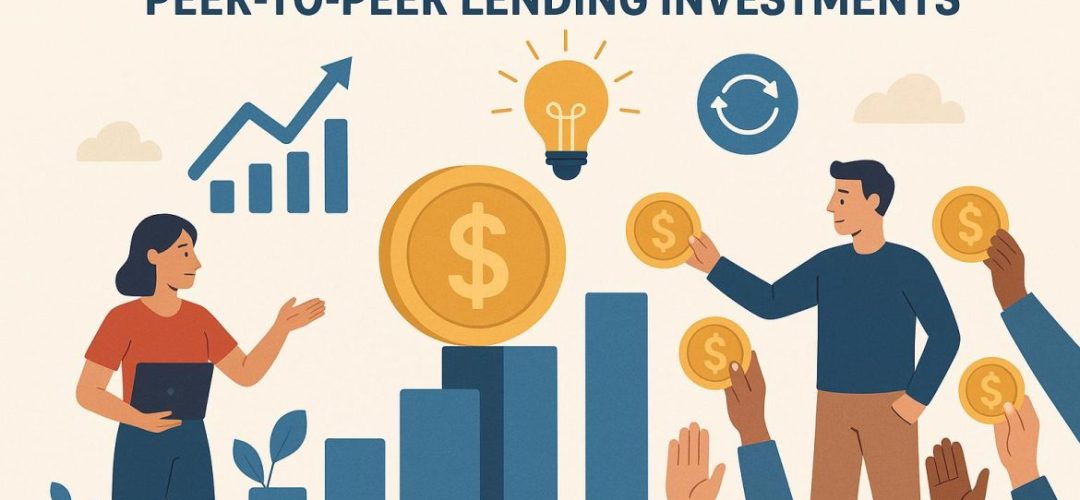
The financial landscape has undergone a seismic shift over the last decade. Traditional gatekeepers—banks and institutional lenders—no longer hold a monopoly over how capital moves. For individual investors seeking to diversify away from the volatility of the stock market or the low yields of savings accounts, alternative investments like Crowdfunding and Peer-to-Peer (P2P) Lending have emerged as powerful tools.
This article explores the mechanics of these digital-first investment models, their unique risks and rewards, and how to integrate them into a modern portfolio while adhering to best practices for long-term wealth building.
1. Understanding the Basics: Digital Disruption in Finance
At its core, both crowdfunding and P2P lending leverage technology to connect those who have capital (investors) directly with those who need it (borrowers or entrepreneurs). By removing the “middleman,” these platforms often provide better interest rates for borrowers and higher potential returns for investors.
What is Crowdfunding?
Crowdfunding is the practice of funding a project or venture by raising small amounts of money from a large number of people, typically via the internet. In an investment context, this usually refers to Equity Crowdfunding or Real Estate Crowdfunding. Instead of just donating to a cause, you are purchasing a stake in a private company or a specific property.
What is Peer-to-Peer (P2P) Lending?
P2P lending is a method of debt financing that enables individuals to lend money to other individuals or small businesses. Investors receive regular interest payments, similar to how a bank earns interest on a loan. The platform handles the credit checks, legal documentation, and payment processing.
2. The Mechanics of Crowdfunding Investments
Crowdfunding has democratized access to asset classes that were once reserved for “accredited” or high-net-worth investors.
Equity Crowdfunding
When you invest in equity crowdfunding, you are buying shares in a startup or an early-stage company.
- The Potential: If the company goes public (IPO) or is acquired, your small initial investment could grow exponentially.
- The Reality: Startups have a high failure rate. This is a long-term play where liquidity is low; you cannot easily sell your shares until a “liquidity event” occurs.
Real Estate Crowdfunding
This allows you to pool your money with others to invest in commercial or residential real estate.
- REITs vs. Direct Crowdfunding: Unlike publicly traded Real Estate Investment Trusts (REITs), crowdfunding platforms often allow you to pick specific projects—such as an apartment complex in Austin or a warehouse in Berlin.
- Income Streams: Investors typically earn through rental income distributions and a share of the eventual sale profits.
3. Deep Dive into Peer-to-Peer (P2P) Lending
P2P lending turns the traditional banking model on its head. When you deposit money in a bank, the bank lends it out and keeps most of the interest. In P2P lending, you take on the role of the lender.
How it Works
- Platform Listing: A borrower applies for a loan (personal, business, or student loan).
- Credit Grading: The platform assigns a risk grade (e.g., Grade A for low risk, Grade E for high risk).
- Investment: You browse these listings and contribute a small amount (often as low as $25) to several different loans.
- Repayment: As the borrower pays back the principal and interest, the funds are credited to your account.
Diversification is Key
To mitigate the risk of a single borrower defaulting, experienced P2P investors spread their capital across hundreds of “notes.” If one borrower fails to pay, the interest from the remaining successful loans should ideally cover the loss and still provide a profit.
4. Risks vs. Rewards: A Balanced View
Every investment carries risk, and alternative lending is no exception. Understanding these factors is crucial for maintaining a healthy portfolio.
The Rewards
- Higher Yields: In a low-interest-rate environment, P2P lending and crowdfunding can offer returns ranging from 5% to 15%, significantly higher than traditional bonds.
- Low Correlation: These investments often don’t move in tandem with the S&P 500, providing a buffer during stock market crashes.
- Accessibility: Digital platforms make it easy to start with small amounts of capital.
The Risks
- Default Risk: In P2P lending, there is no government insurance (like FDIC) protecting your investment. If the borrower defaults, you may lose your principal.
- Platform Risk: If the crowdfunding platform itself goes bankrupt, recovering your assets can be a complex legal process.
- Liquidity Risk: Unlike stocks, which you can sell in seconds, your money is often “locked” for the duration of the loan or until a property/business is sold.
5. Strategic Implementation for Investors
How should you approach these assets? They should generally complement, not replace, a diversified portfolio of stocks and bonds.
1. Start Small and Diversify
Do not put more than 5% to 10% of your total portfolio into alternative lending. Within that allocation, ensure you are spread across different loan grades, industries, and geographic locations.
2. Research the Platform
Before committing funds, investigate the platform’s track record.
- What is their historical default rate?
- How do they vet their borrowers or projects?
- Are they transparent about their fees?
3. Reinvest for Compound Growth
The power of P2P lending lies in compounding. Most platforms offer an “auto-invest” feature that automatically takes the interest you earn and reinvests it into new loans, keeping your capital working 24/7.
6. The Role of Regulation and Policy
Modern fintech platforms operate under strict regulatory frameworks to protect consumers. In the U.S., the SEC regulates equity crowdfunding under the JOBS Act, which sets limits on how much individuals can invest based on their income. Similarly, European and Asian markets have updated their fiscal policies to ensure platform transparency and anti-fraud measures.
For the investor, this means better access to data and more “standardized” reporting, making it easier to compare different investment opportunities across the globe.
Conclusion
Crowdfunding and P2P lending represent the democratization of finance. They offer a unique path to passive income and portfolio growth by cutting out traditional intermediaries. However, success in this space requires a disciplined approach, a focus on diversification, and a clear understanding of the underlying risks.
As digital education and financial literacy continue to rise, these alternative investments will likely become a staple for the modern, tech-savvy investor. By staying informed and utilizing the right platforms, you can turn the digital economy into a personal wealth-building engine.
Disclaimer: This article is for informational purposes only and does not constitute financial advice. Always consult with a qualified financial professional before making investment decisions.
Would you like me to generate a list of the top-rated crowdfunding and P2P platforms for 2026 to include as a supplementary resource?
Cosmetologie Ciocana, Epilare laser ciocana, Epilare definitiva cu laser in Chișinau, лазерная эпиляция кишинев, парикмахер Кишинев, Cosmetologie Ciocana, Прокат автомобилей кишинев, rent a car, arenda auto aeroport md, Прокат автомобилей в аэропорту Кишинева, chirie auto moldova, inchiriere auto chisinau Chirie auto Chisinau, Chirie Auto Chisinau, Chirie Auto ieftine, Chirie Auto Aeroport Chișinău, Лазерная эпиляция в Кишиневе, Închirieri auto la aeroport Chișinău, Chirie auto Chisinau, Apa si Codru,