
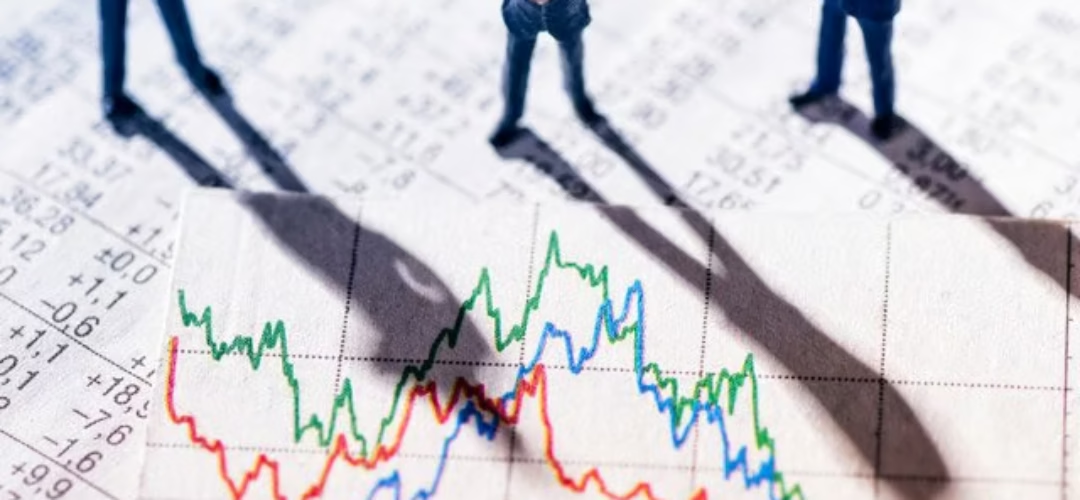
In the ever-evolving landscape of global finance, 2026 has emerged as a year defined by “calculated uncertainty.” While traditional markets—specifically stocks and bonds—often react instantaneously to geopolitical shifts and interest rate fluctuations, the world of alternative assets operates on a different frequency.
Understanding how market volatility impacts private equity, real estate, hedge funds, and digital assets is no longer just for institutional giants; it is essential knowledge for the modern diversified investor.
1. Defining the “Alternative” Shield in a Volatile Climate
Alternative assets are generally defined as any investment category excluding cash, stocks, and bonds. Their primary appeal during periods of high volatility is low correlation. When the S&P 500 or the Nasdaq experience sharp pullbacks, alternative assets often do not move in lockstep.
The Mechanism of Lagged Valuation
Unlike public stocks, which are valued every second, many alternative assets (like private equity and real estate) use quarterly valuations. This creates a “smoothing effect.” While this doesn’t mean the assets are immune to economic downturns, it prevents the panic-selling cycles often seen in retail brokerage apps.
2. Private Equity: From Multiples to Operational Alpha
In previous decades, private equity (PE) thrived on “multiple expansion”—buying a company and selling it later at a higher price purely due to market growth. In 2026, volatility has changed the playbook.
- The Exit Bottleneck: High volatility often closes the “IPO window.” When public markets are turbulent, PE firms struggle to take their portfolio companies public, leading to longer holding periods.
- The Rise of Secondaries: To combat liquidity issues, we have seen a massive surge in the secondary market. Investors looking for quick exits sell their stakes at a discount to other private buyers, providing a release valve for the industry.
- Operational Value: Success in 2026 is driven by “Operational Alpha.” Firms are now focusing on using AI and lean management to increase a company’s actual earnings (EBITDA) rather than waiting for a better market mood.
3. Real Estate: Navigating the Interest Rate Seesaw
Real estate remains a cornerstone of alternative investing, but its reaction to volatility is twofold.
Commercial vs. Residential Resilience
While the “work-from-home” hangover still affects traditional office spaces, 2026 has seen a pivot toward Data Centers and Logistics Hubs. These sub-sectors are considered “volatility-resistant” because their demand is tied to the structural growth of the digital economy, not daily market sentiment.
The Inflation Hedge
One of the greatest strengths of real estate during volatile, inflationary periods is the ability to adjust rents. Multi-family residential units, for instance, act as a natural hedge; as prices rise, so do leases, maintaining the investor’s real-term purchasing power.
4. Hedge Funds: The Volatility Voyagers
While other assets seek to avoid volatility, hedge funds often thrive on it.
- Macro Strategies: Global Macro funds analyze political and economic shifts to bet on currency movements and interest rate changes. For these managers, a “boring” market is a risk; a volatile market is an opportunity.
- Equity Long/Short: By holding both “buy” and “sell” positions, these funds aim to cancel out market-wide movements (Beta) and profit only from the individual performance of specific companies (Alpha).
Investor Note: Hedge funds are high-risk, high-reward vehicles. In 2026, the gap between the top-performing 10% and the bottom 10% of managers has widened significantly, emphasizing the importance of due diligence.
5. Digital Assets and “Digital Gold” 2.0
As of 2026, the narrative around cryptocurrencies has shifted. No longer viewed purely as speculative “memecoins,” major digital assets like Bitcoin have begun to show characteristics of institutional collateral.
When traditional banking systems face “friction” or localized volatility, capital often flows into decentralized finance (DeFi) and established tokens. However, the “crypto-volatility” remains an order of magnitude higher than traditional alternatives, making it a high-conviction play rather than a safe haven for the faint of heart.
6. Strategies for Portfolios in 2026
How should an investor adapt their “Alternatives” strategy to a volatile world?
- Prioritize Liquidity Solutions: Look for “semi-liquid” funds or “evergreen” structures that allow for monthly or quarterly redemptions.
- Focus on Private Credit: With banks becoming more conservative during volatile times, private lending has become a powerhouse. Investors can act as the “bank,” earning high-single-digit yields with seniority in the capital stack.
- Diversify the Alternatives: Don’t just buy “Real Estate.” Mix infrastructure, private credit, and perhaps a small allocation to “passion assets” like fine art or vintage wine, which have shown remarkable price stability in 2025-2026.
7. The Risks: What to Watch Out For
No investment is without peril. When volatility hits, two specific risks rise for alternative assets:
- Valuation Lag Risk: If the market crashes 20% in a month, your private equity fund might still show a “flat” value. This can create a false sense of security.
- Capital Calls: In private equity, you don’t just “buy” a fund; you commit capital. During volatile times, if a fund calls for your committed cash while your other stocks are down, you may face a liquidity crunch.
Conclusion: The New Balanced Portfolio
The old “60/40” (60% stocks, 40% bonds) rule is increasingly viewed as insufficient for the volatility of the mid-2020s. Institutional investors are now moving toward a “50/30/20” model, where 20% is dedicated to alternative assets.
By decoupling a portion of your wealth from the daily “noise” of the stock ticker, you gain something more valuable than just returns: the psychological resilience to stay invested for the long term.
Disclaimer
This article is for informational purposes only and does not constitute financial, investment, or legal advice. Alternative investments involve a high degree of risk and may not be suitable for all investors. Always consult with a qualified financial advisor before making significant investment decisions.