
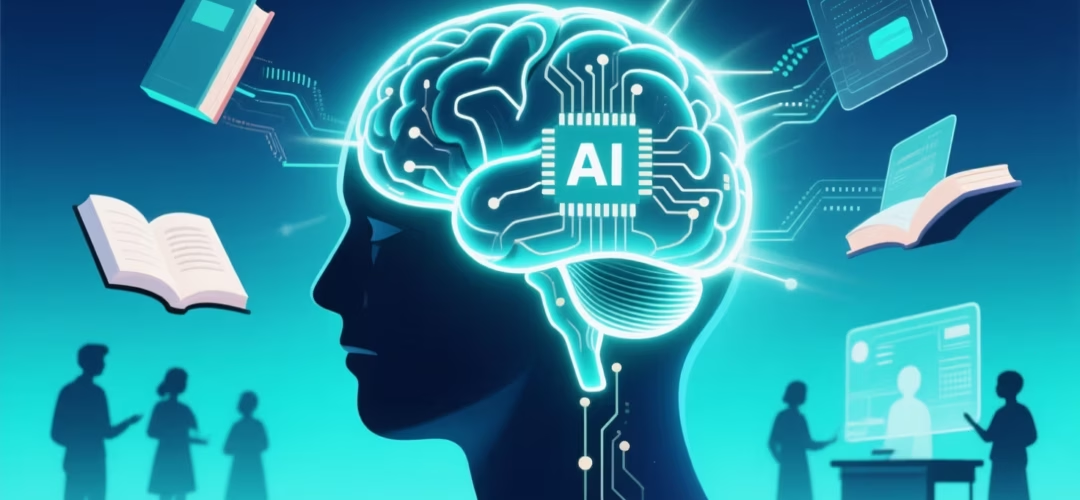
The integration of Artificial Intelligence (AI) into the educational sector is no longer a futuristic concept outlined in science fiction. Today, it stands as one of the most transformative forces in modern pedagogy. From automated administrative tasks to highly sophisticated personalized learning pathways, AI is fundamentally restructuring how teachers teach and how students learn.
As digital environments evolve, understanding the profound shifts brought about by AI is essential for educators, policymakers, and learners alike. This article explores how AI is reshaping education, the tangible benefits it brings to the classroom, the challenges it introduces, and what the future holds for the democratization of knowledge.
1. Personalized Learning Pathways
For decades, the traditional education system has relied on a “one-size-fits-all” model. In a standard classroom, a single teacher must accommodate dozens of students, each possessing unique learning speeds, strengths, and cognitive gaps. AI breaks this paradigm through intelligent tutoring systems (ITS) and adaptive learning platforms.
How Adaptive Learning Works
AI algorithms analyze a student’s performance in real time. If a learner excels at a specific mathematical concept, the system automatically accelerates them to more complex tasks. Conversely, if a student struggles with a reading comprehension exercise, the AI flags the bottleneck, provides alternative explanations, and offers targeted practice modules.
- Customized Formatting: Materials can be adapted for visual, auditory, or kinesthetic learners.
- Targeted Remediation: Instead of waiting for a midterm exam to discover a gap in knowledge, AI identifies and addresses misunderstandings immediately.
- Increased Engagement: By keeping content within a student’s “Zone of Proximal Development”—neither too easy to cause boredom nor too difficult to cause frustration—AI sustains higher engagement rates.
2. Empowering Educators through Automation
A common misconception is that AI aims to replace human teachers. In reality, its primary objective is to liberate educators from the bureaucratic and repetitive tasks that lead to professional burnout.
Administrative Relief
Teachers routinely spend hours grading assignments, managing attendance, and organizing lesson plans. Machine learning algorithms can now grade objective assessments, multiple-choice tests, and even standard essays with remarkable accuracy.
Data-Driven Insights
AI platforms compile student data into comprehensive dashboards. Instead of spending hours analyzing spreadsheets, a teacher can glance at an AI-generated report to instantly see which students are falling behind, which concepts the entire class misunderstood, and where curriculum adjustments are required. This allows educators to dedicate their time to what they do best: mentoring, facilitating discussions, and providing emotional and social support.
3. Democratizing Education and Global Accessibility
Geography, socioeconomic status, and physical disabilities have historically limited access to high-quality education. AI acts as a powerful equalizer by breaking down these traditional barriers.
Breaking Language Barriers
AI-powered translation tools and natural language processing (NLP) enable students to access world-class educational content in their native languages. Complex academic papers or video lectures can be translated and subtitled accurately in real time, fostering global knowledge exchange.
Enhanced Accessibility Tools
For students with special needs, AI is life-changing:
- Visually Impaired Students: AI-driven computer vision tools can describe images, charts, and diagrams textually, or convert text to highly natural speech.
- Hearing Impaired Students: Advanced speech-to-text algorithms provide accurate, instantaneous captioning for live lectures.
- Neurodivergent Learners: AI assistants can simplify complex text structures or break down overwhelming assignments into step-by-step, manageable checklists.
4. The Challenges and Ethical Considerations
While the benefits of AI in education are vast, the rapid deployment of these technologies introduces critical ethical, technical, and structural challenges that cannot be ignored.
Data Privacy and Security
AI systems rely on massive amounts of data to function effectively. In an educational context, this involves collecting sensitive student information, including academic performance, behavioral patterns, and personal identifiers. Protecting this data from breaches and ensuring compliance with global privacy regulations (such as GDPR or COPPA) is paramount. Educational institutions must ensure that AI vendors adhere to strict data-governance policies.
The Risk of Algorithmic Bias
AI models are trained on historical data. If the training data contains implicit biases regarding race, gender, or socioeconomic backgrounds, the AI can perpetuate or even amplify these biases. For instance, an automated grading or admissions algorithm might unfairly disadvantage certain student demographics if the underlying code is not rigorously audited for equity.
Academic Integrity and Plagiarism
The rise of generative AI tools, such as large language models (LLMs), has created an existential crisis for traditional assessment methods. Students can now generate essays, solve complex coding problems, and complete homework assignments in seconds.
The Shift in Assessment: Educators are forced to move away from rote memorization and essay-based homework. The focus is shifting toward oral presentations, critical thinking exams, in-class proctored assessments, and projects that require original, practical application.
5. The Future: A Hybrid Human-AI Ecosystem
The future of education does not belong to AI alone, nor does it belong to entirely analog methods. It lies in a collaborative, hybrid model where technology enhances human capability.
| Aspect | Role of Artificial Intelligence | Role of the Human Educator |
| Instruction | Provides data-driven tutoring, practice, and immediate feedback. | Facilitates critical thinking, ethical debates, and collaborative projects. |
| Evaluation | Analyzes quantitative performance and tracks systemic learning gaps. | Assesses emotional growth, creativity, resilience, and soft skills. |
| Support | Offers 24/7 availability for conceptual questions and study scheduling. | Provides empathy, mentorship, career guidance, and emotional support. |
As virtual reality (VR) and augmented reality (AR) merge with AI, the classrooms of tomorrow will offer immersive, simulated environments. Students will be able to explore the surface of Mars, conduct virtual chemistry experiments without safety risks, or walk through historical re-enactments—all guided by an AI tutor tailored to their specific learning style, under the mentorship of a professional educator.
Conclusion
Artificial Intelligence is fundamentally rewriting the educational landscape. By offering unprecedented personalization, reducing administrative burdens on teachers, and making learning accessible to diverse populations, AI holds the promise of a more equitable and effective educational system.
However, realizing this potential requires a careful, balanced approach. Stakeholders must proactively address challenges related to data privacy, ethical bias, and academic integrity. When implemented responsibly, AI will not diminish the role of the teacher; instead, it will elevate the profession, turning educators into orchestrators of profound, personalized, and inspiring learning experiences.