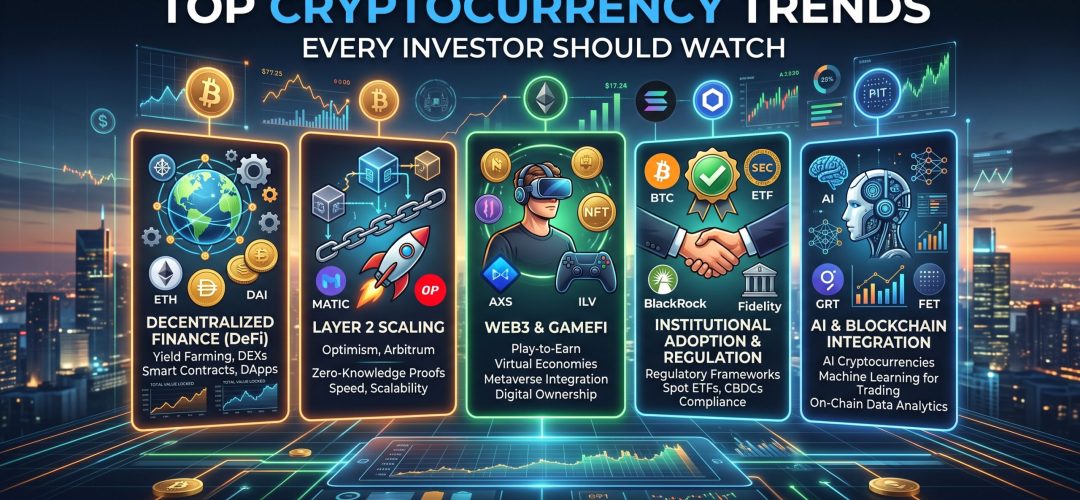
The cryptocurrency ecosystem is experiencing a structural transition from speculative retail momentum toward enterprise-grade utility, institutional integration, and clear regulatory compliance. For investors, navigating this evolving market requires moving beyond short-term market cycles to focus on fundamental shifts shaping the future of global finance.
Understanding the key cryptocurrency trends transforming the blockchain landscape provides critical insight for building a resilient, forward-looking portfolio.
1. Real-World Asset (RWA) Tokenization
Real-World Asset (RWA) tokenization is bridging traditional finance (TradFi) and decentralized infrastructure. Financial institutions are digitizing tangible assets—such as U.S. Treasury bills, corporate bonds, real estate, and private debt—directly onto blockchain networks.
Traditional Asset (e.g., Treasury Bill) ──► Smart Contract Minting ──► Fractionalized Token on Chain
Tokenization provides distinct structural advantages over traditional settlement models:
- Fractional Ownership: Lower entry barriers allow investors to purchase smaller yield-generating portions of high-value assets.
- Instant Settlement: On-chain issuance reduces clearing and settlement friction from days ($T+2$) to real-time execution.
- Programmable Yield: Automated smart contracts handle distribution of dividends, interest, and coupon payments.
With global asset managers launching tokenized liquidity funds, RWAs are transforming blockchain from an alternative asset class into a foundational settlement layer.
2. Convergence of Artificial Intelligence and Blockchain
Artificial intelligence and decentralized protocols are merging to solve critical operational challenges in both domains. While AI relies heavily on computing power and vast datasets, blockchain provides verifiable identity, decentralized compute power, and trustless payment rails.
Key applications in this emerging sector include:
- Autonomous AI Agents: On-chain AI agents capable of executing autonomous portfolio rebalancing, arbitrage strategies, and liquidity management via smart contracts.
- Decentralized Physical Infrastructure Networks (DePIN): Networks aggregating GPU compute power globally, allowing AI developers to access hardware at lower costs compared to centralized cloud providers.
- Data Verification & Provenance: Blockchain-based cryptographic proofs ensuring dataset authenticity and preventing AI-generated deepfakes or data tampering.
3. Maturation of Layer-2 Scaling and Modular Architecture
Scalability limitations on foundational Layer-1 blockchains like Ethereum have driven rapid adoption across Layer-2 (L2) networks and modular blockchain architectures.
Instead of requiring a single network to execute transactions, maintain consensus, and store data simultaneously, modular designs separate these responsibilities:
| Layer Type | Dominant Technologies | Primary Value Proposition |
| Execution Layer (L2) | Zero-Knowledge Rollups (ZK-Rollups), Optimistic Rollups | High throughput, sub-cent transaction costs |
| Data Availability (DA) | Dedicated DA Networks, Proto-Danksharding | Offloading transaction storage to keep fees low |
| Consensus Layer (L1) | Ethereum, Bitcoin | Settlement security and cryptographic finality |
This structural maturation enables decentralized applications (dApps) to scale seamlessly, accommodating millions of daily active users without compromising network stability.
4. Institutional Adoption and Regulatory Clarity
Regulatory developments across major economic jurisdictions are replacing legal ambiguity with structured compliance frameworks. Legislative frameworks like Europe’s Markets in Crypto-Assets (MiCA) regulation and updated guidelines in the United States have established clear rules for digital asset custodians, stablecoin issuers, and exchange operators.
Regulatory Frameworks (e.g., MiCA, U.S. Guidelines)
       │
       ▼
Institutional Capital Entry (ETFs, Treasury Reserves, Custody Banks)
       │
       ▼
Market Stability & Long-Term Liquidity Expansion
Clear legal standards encourage institutional participation through spot exchange-traded funds (ETFs), corporate treasury allocations, and permissioned DeFi lending pools designed for accredited participants.
5. Evolution of Stablecoins as Payment Infrastructure
Stablecoins have evolved beyond basic trading pairs on crypto exchanges to become essential international payment channels. Supported by strict reserve auditing standards, fiat-backed stablecoins facilitate global remittances, cross-border business transactions, and merchant settlements.
Key drivers of stablecoin integration include:
- Cost Savings: Cross-border transfer fees drop significantly compared to legacy wire transfers and SWIFT payments.
- Continuous Operations: On-chain payments operate 24/7/365 without bank holiday delays or processing windows.
- Yield-Bearing Variants: Yield-bearing stablecoins pass money market returns back to holders via underlying tokenized Treasuries.
Risk Management Strategies for Digital Asset Investors
While technological advancements create compelling market opportunities, digital asset investing requires disciplined risk mitigation strategies:
- Focus on Fundamental Utility: Prioritize protocols backed by real transaction fee revenue, active network developers, and clear ecosystem utility rather than speculative market sentiment.
- Diversify Across Sectors: Balance high-beta exposure (such as AI or DePIN tokens) with foundational assets (Bitcoin, Ethereum) and income-generating RWAs.
- Prioritize On-Chain Security: Leverage hardware wallets for self-custody and evaluate smart contract audit track records before interacting with decentralized finance protocols.
Strategic Outlook
The digital asset market is shifting toward institutional adoption, regulatory integration, and real-world utility. By focusing on RWA tokenization, AI convergence, scaling infrastructure, and stablecoin payment rails, investors can position themselves strategically within the modern digital economy.