
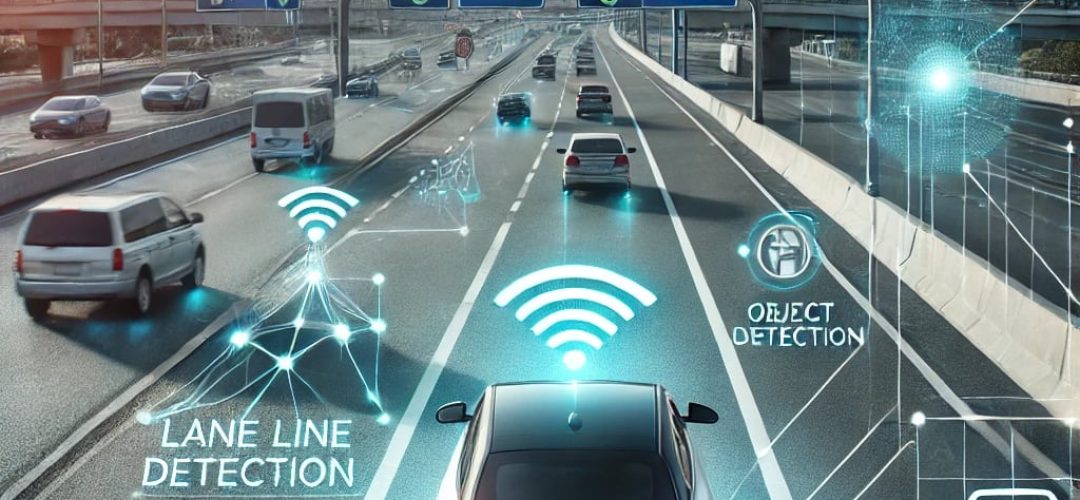
The dream of self-driving cars has shifted from the realm of science fiction into a tangible, rapidly evolving reality. At the core of this revolution is Artificial Intelligence (AI). AI serves as the brain, nervous system, and sensory organs of modern autonomous vehicles (AVs), fundamentally altering how we move people and goods. As urban centers grow more congested and the demand for efficient, safe logistics escalates, understanding the integration of AI in transportation becomes vital.
This article explores how AI powers self-driving technology, its broader impact on global transportation ecosystems, the engineering challenges it faces, and what the future holds for this transformative technology.
The AI Stack: How Autonomous Vehicles “Think”
An autonomous vehicle relies on a continuous loop of data collection, processing, and execution. To replace a human driver, the vehicle’s AI must successfully execute three core tasks: perception, localization and mapping, and path planning.
+-------------------------------------------------------------+
|                         PERCEPTION                          |
|  (Camera, LiDAR, Radar data analyzed via CNNs/Transformers) |
+-------------------------------------------------------------+
                              |
                              v
+-------------------------------------------------------------+
|                  LOCALIZATION & MAPPING                     |
|         (SLAM algorithms pinpointing vehicle inside         |
|                 high-definition 3D maps)                    |
+-------------------------------------------------------------+
                              |
                              v
+-------------------------------------------------------------+
|                   PATH PLANNING & CONTROL                   |
|       (Reinforcement Learning calculating safe routes       |
|                 and executing maneuvers)                    |
+-------------------------------------------------------------+
1. Perception (Seeing the World)
Human drivers use their eyes and ears; AVs use an array of sensors including cameras, Radar, and LiDAR (Light Detection and Ranging). However, raw sensor data is useless without interpretation.
AI models, specifically Convolutional Neural Networks (CNNs) and Vision Transformers, process these massive data streams in real time. The AI performs object detection, classification, and tracking. It differentiates between a pedestrian, a cyclist, a plastic bag blowing in the wind, and a concrete barrier, estimating the speed and trajectory of each object instantly.
2. Localization and Mapping (Knowing Where You Are)
Standard GPS is only accurate within a few meters—not nearly precise enough to keep a car safely in its lane. AI uses a technique called SLAM (Simultaneous Localization and Mapping) combined with pre-existing high-definition (HD) maps. By matching real-time sensor data with millimeter-accurate 3D maps, the AI calculates the vehicle’s exact position relative to curbs, lane markings, and traffic signals.
3. Path Planning and Decision Making (Executing the Drive)
Once the vehicle knows its environment and its exact position, it must decide what to do next. This is where Deep Reinforcement Learning (DRL) comes into play. The AI predicts the behavior of surrounding traffic and plans a safe path forward. It calculates the optimal speed, steering angle, and braking pressure, smoothly executing maneuvers like lane changes, highway merging, and defensive braking.
Transforming the Broader Transportation Ecosystem
The impact of AI extends far beyond individual passenger cars. Entire logistics networks and public transit systems are being redesigned around intelligent automation.
Smart Fleet Management and Logistics
In long-haul trucking, AI is addressing severe driver shortages and optimizing supply chains. Autonomous trucks can operate virtually 24/7 without the fatigue constraints that human drivers face. Furthermore, AI algorithms optimize routing based on real-time weather, traffic, and fuel efficiency data, drastically lowering greenhouse gas emissions for freight fleets.
Ride-Hailing and Robo-Taxis
Urban mobility is seeing a massive shift with the deployment of commercial robo-taxi fleets in major global cities. AI dynamically balances vehicle supply with passenger demand, predicts high-traffic zones, and dispatches cars efficiently. This model reduces the need for private car ownership, potentially freeing up massive amounts of urban space currently dedicated to parking.
Traffic Flow and Smart Cities
When autonomous vehicles connect with city infrastructure—a concept known as V2X (Vehicle-to-Everything) communication—AI can optimize entire traffic networks. Smart traffic lights adjusted by AI can change intervals based on actual traffic volume rather than rigid timers, dramatically reducing urban gridlock and grid-level fuel waste.
Key Challenges Facing AI in Transportation
Despite incredible technological milestones, full Level 5 autonomy (complete automation under any conditions without human intervention) still faces steep engineering and societal hurdles.
- The “Edge Case” Problem: AI excels at predictable driving environments, but struggles with rare, unpredictable events (edge cases). A person riding a unicycle on a highway, an unmapped construction zone with complex hand signals from a worker, or extreme weather conditions like blinding blizzards can confuse neural networks.
- Sensor Fusion Flaws: Combining data from cameras, radar, and LiDAR is incredibly complex. If a camera sees a shadow but radar detects a solid object, the AI must instantly decide which sensor to trust. Miscalculations here can lead to phantom braking or, worse, critical collisions.
- Ethical and Regulatory Dilemmas: If a crash is mathematically unavoidable, how should the AI choose to minimize harm? Programmers and policymakers are still debating the ethical frameworks required to govern these decisions, alongside establishing standardized safety validation metrics.
The Road Ahead
The integration of AI into vehicles is progressing via a tiered evolutionary scale defined by the Society of Automotive Engineers (SAE):
| Autonomy Level | Description | Role of AI | Current Status |
| Level 2 (Partial) | Driver must remain fully engaged. | Lane-centering, adaptive cruise control. | Standard in most new production vehicles. |
| Level 3 (Conditional) | Vehicle drives under specific conditions; driver must be ready to take over. | Environmental monitoring, traffic jam pilots. | Available in select luxury models globally. |
| Level 4 (High) | Full autonomy within a geofenced area or specific parameters. | Total vehicle control; no driver interaction required within the zone. | Active deployment in commercial robo-taxis and cargo logistics. |
As AI algorithms mature and computing hardware becomes more energy-efficient, the line between Level 4 and Level 5 autonomy will blur. The transition will not happen overnight, but rather through a steady expansion of the operational design domains where AI can drive safely.
The Big Takeaway: The ultimate goal of AI in transportation is not just convenience, but safety. Over 90% of vehicular accidents are caused by human error, distraction, or fatigue. By substituting human fallibility with rigorous, millisecond-fast algorithmic precision, AI holds the potential to save hundreds of thousands of lives globally every single year.
The future of transportation is autonomous, connected, and deeply intelligent. As the technology continues to mature, it will reshape our cities, economies, and daily routines, making mobility safer, cleaner, and more accessible for everyone.