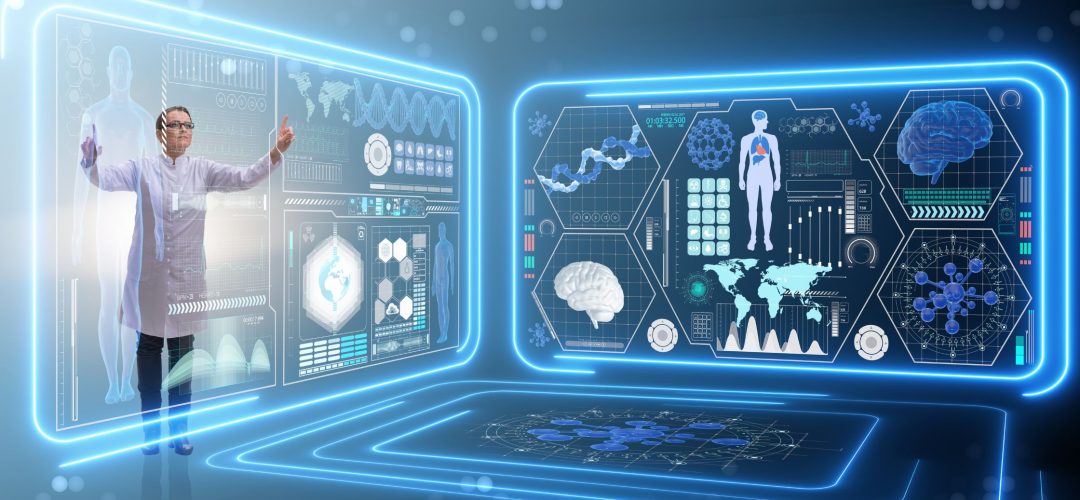
The intersection of artificial intelligence (AI) and medicine is transforming the healthcare landscape at a pace never seen before. Technologies that once belonged to the realm of science fiction—such as predictive diagnostics, robotic-assisted surgeries, and generative AI for drug discovery—are now actively reshaping clinical workflows.
Far from replacing human professionals, AI is stepping in as an advanced collaborator. It processes massive datasets, automates administrative burdens, and provides deep insights to help doctors make faster, more accurate decisions. This article explores the primary ways AI is revolutionizing medicine, its real-world impacts, and the ethical challenges that lie ahead.
1. Advanced Diagnostics and Early Disease Detection
One of AI’s most profound impacts is in medical imaging and diagnostics. Machine learning algorithms, particularly deep learning models trained on millions of clinical images, can detect patterns that might escape even the most experienced human eyes.
- Radiology and Oncology: AI models can analyze X-rays, MRIs, and CT scans to identify early-stage tumors, microscopic fractures, or neurological anomalies. In mammography, AI systems assist radiologists by flagging suspicious tissue, reducing both false negatives and the anxiety of false positives.
- Pathology: Digital pathology leverages AI to scan tissue slides at a microscopic level. The algorithm can count cancerous cells, grade tumors, and predict disease progression with remarkable speed, significantly reducing the time patients wait for biopsy results.
- Genomics: By processing a patient’s genetic profile, AI can identify specific mutations that predispose them to chronic diseases or rare conditions, allowing for preventive interventions years before symptoms appear.
2. Accelerating Drug Discovery and Development
Traditionally, bringing a new drug to market is a notoriously slow and expensive process. It often takes over a decade and billions of dollars, with a high failure rate during clinical trials. AI is completely disrupting this timeline.
How AI Compresses the R&D Timeline
Instead of relying solely on physical trial-and-error in a lab, researchers use AI to simulate molecular interactions digitally.
- Target Identification: AI analyzes biological data to find the exact proteins or pathways responsible for a disease.
- Molecular Design: Generative AI can design entirely new synthetic molecules optimized to bind to those disease targets, bypassing months of manual chemistry work.
- Predicting Toxicity: Before a compound ever enters a physical lab, machine learning models predict how toxic it might be to human cells, filtering out unsafe options early on.
What used to take five to seven years in the pre-clinical phase can now sometimes be completed in a matter of months, drastically lowering costs and accelerating life-saving treatments for conditions like ALS, Alzheimer’s, and various cancers.
3. Precision Medicine and Personalized Care
For decades, medicine operated on a “one-size-fits-all” model. If a patient had a specific diagnosis, they received the standard protocol. However, because every human body is genetically and environmentally unique, treatments work beautifully for some but fail for others.
AI acts as the catalyst for precision medicine—tailoring healthcare to the individual.
[Patient Data: Genetics + Lifestyle + History]
                      │
                      ▼
             [AI Analysis Engine]
                      │
                      ▼
         [Personalized Treatment Plan]
By analyzing a patient’s complete medical history, lifestyle factors, environment, and genetic makeup, AI engines can predict which therapies will yield the highest success rate with the fewest side effects. This approach is highly prevalent in modern oncology, where treatments are designed around the specific genetic mutations of a patient’s tumor.
4. Enhancing Clinical Workflows and Administrative Efficiency
While medical breakthroughs capture headlines, a significant portion of AI’s value lies in solving the operational crisis plaguing global healthcare systems: burnout. Doctors and nurses spend hours every day updating Electronic Health Records (EHRs) and managing paperwork.
- Ambient Clinical Intelligence: Using natural language processing (NLP), AI tools can securely listen to a doctor-patient conversation and automatically generate structured clinical notes. This allows physicians to focus entirely on the patient rather than typing into a screen.
- Predictive Hospital Management: AI algorithms analyze historical admission data, weather patterns, and local viral outbreaks to forecast hospital bed demand and emergency room traffic. This helps administrators optimize staffing levels and resource allocation.
- Triage Optimization: Chatbots and virtual assistants can interact with patients to assess symptoms, answer basic medical questions, and route individuals to the appropriate level of care, preventing emergency rooms from becoming overwhelmed by non-urgent cases.
5. Robotic-Assisted Surgery and Remote Care
Robots are not performing surgeries autonomously, but when paired with AI, they give surgeons superhuman precision.
During minimally invasive procedures, AI-powered robotic systems stabilize a surgeon’s hand movements, filtering out natural micro-tremors. Furthermore, real-time computer vision can overlay anatomical data directly onto the surgeon’s view, highlighting critical blood vessels or hidden nerves that must be avoided.
On the post-operative side, wearable IoT (Internet of Things) devices integrated with AI allow for continuous remote patient monitoring. If a patient recovering at home shows early signs of cardiac distress or a sudden drop in oxygen saturation, the AI instantly alerts the medical team, preventing re-hospitalization through early intervention.
The Ethical Challenges and the Road Ahead
Despite the immense benefits, integrating AI into healthcare introduces critical ethical and operational responsibilities that tech developers and medical institutions must address:
Data Privacy and Security: Medical data is highly sensitive. Standardizing AI integration requires robust, encrypted systems that comply with global regulations (such as HIPAA in the US or GDPR in Europe) to protect patient identity from cyber threats.
Algorithmic Bias: If an AI model is trained primarily on data from a single demographic, its diagnostic accuracy may drop when applied to underrepresented populations. Continuous diversification of medical datasets is vital to ensure equitable healthcare.
The Liability Question: If an AI assists in a diagnosis that turns out to be incorrect, who holds the responsibility—the software developer, the hospital, or the physician? Regulatory bodies like the FDA are continually updating frameworks to clearly define AI as a supportive “medical device” rather than a final decision-maker.
Conclusion
Artificial intelligence is fundamentally shifting medicine from a reactive discipline to a proactive, predictive science. By eliminating administrative bottlenecks, unlocking the secrets of our genetic code, and catching lethal diseases at their inception, AI is ultimately buying humanity the most valuable currency of all: time. As developers and clinicians collaborate to solve the puzzles of data privacy and algorithmic bias, the partnership between human empathy and artificial intelligence promises to usher in an unprecedented era of global health and well-being.