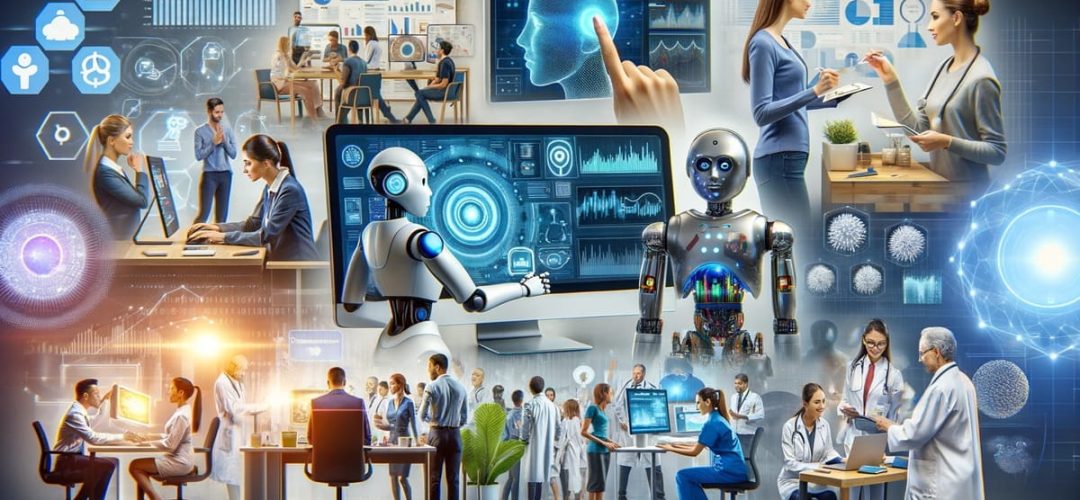
The modern workplace is undergoing its most significant transformation since the Industrial Revolution. At the heart of this evolution is Artificial Intelligence (AI). Once a staple of science fiction, AI has rapidly matured into a core operational driver across global industries. Far from merely automating repetitive tasks, artificial intelligence is reshaping organizational structures, redefining human roles, and introducing entirely new paradigms for productivity and collaboration.
Understanding this shift is no longer just an academic exercise; it is a business imperative. Organizations that successfully integrate AI are unlocking unprecedented efficiencies, while professionals who master these tools are positioning themselves at the forefront of the modern economy.
1. The Automation of Routine Tasks and the Rise of “Augmented Productivity”
For decades, automation was synonymous with physical robotics handling repetitive manufacturing tasks. AI changes the game by bringing automation to cognitive, data-driven processes.
In departments like human resources, finance, and customer service, AI-powered software handles high-volume, repetitive tasks with absolute precision. For example, AI algorithms can sift through thousands of resumes to identify top talent, process complex invoices, or handle routine customer inquiries via advanced natural language processing (NLP) bots.
However, the true value of AI lies not in replacing human workers, but in augmentation. When employees are freed from mundane, administrative tasks, they can redirect their energy toward high-value activities that require uniquely human skills:
- Strategic Planning: Interpreting AI-generated data to map out long-term business goals.
- Creative Problem Solving: Tackling complex organizational challenges that lack structured data.
- Emotional Intelligence: Building deep relationships with clients, managing team dynamics, and fostering a collaborative workplace culture.
This shift transforms the workforce from a model of execution to one of optimization, where humans act as the strategic directors of AI capabilities.
2. Data-Driven Decision Making and Corporate Valuation
In the traditional corporate landscape, decision-making often relied on a mix of historical data, market intuition, and trial-and-error. AI eliminates much of this ambiguity by processing massive datasets in real time to provide predictive insights.
In financial sectors and corporate management, AI algorithms analyze market trends, consumer behavior, and operational metrics to forecast future outcomes. This has a profound impact on corporate valuation methods. Analysts can now project cash flows, assess risk profiles, and evaluate asset performance with a granularity that was previously impossible.
Key Insight: AI-driven predictive analytics allow companies to transition from reactive management (responding to past quarters) to proactive strategy (anticipating market shifts before they happen).
Furthermore, this data-centric approach optimizes resource allocation. Companies can precisely identify which projects yield the highest return on investment (ROI), where supply chain bottlenecks are likely to occur, and how to optimize pricing strategies dynamically.
3. The Cybersecurity Evolution in the AI Era
As workplaces become more digital and interconnected, the surface area for potential security breaches expands exponentially. Malicious actors are increasingly using sophisticated techniques, making traditional, signature-based security systems insufficient. This is where AI plays a dual role in the modern workplace: as a shield and a subject of protection.
Cyber Defense and Fraud Detection
AI-driven security systems constantly monitor network traffic, user behavior, and data transfers to establish a baseline of “normal” activity. The moment an anomaly occurs—such as an unauthorized data download or a login attempt from an unusual location—the AI can flag or isolate the threat within milliseconds. This speed is vital for mitigating financial fraud and protecting proprietary corporate data.
The Changing Threat Landscape
Conversely, businesses must prepare for AI-driven threats. Phishing attacks have become significantly more convincing due to generative AI’s ability to mimic professional writing styles and corporate jargon. Understanding these evolving tactics is essential for modern workforce training; identity theft prevention and digital asset protection are now core responsibilities for every employee, not just the IT department.
4. Sustainability and Green Technology in AI Operations
As corporate sustainability moves from a secondary checklist item to a core pillar of corporate strategy, AI is proving to be a vital tool for environmental, social, and governance (ESG) goals.
Modern workplaces consume vast amounts of energy, particularly through data centers and corporate facilities. AI smart building systems optimize heating, ventilation, and air conditioning (HVAC) systems based on real-time occupancy and weather forecasts, significantly lowering a company’s carbon footprint.
Beyond facilities, AI optimizes logistics and supply chains to minimize waste. By predicting exact inventory needs and calculating the most fuel-efficient delivery routes, companies can drastically reduce emissions and resource consumption. This intersection of digital transformation and green technology ensures that businesses can scale efficiently while aligning with global sustainability standards.
5. Overcoming the Challenges of AI Integration
While the benefits of AI are vast, the transition is not without significant friction. Organizations looking to adopt these technologies must navigate several critical challenges:
The Skills Gap and Upskilling
The rapid deployment of AI has created a noticeable skills gap. It is no longer enough for workers to be proficient in traditional software; they must learn to interact with AI models effectively. Forward-thinking companies are investing heavily in internal training programs to teach “prompt engineering,” data literacy, and AI tool management, ensuring their workforce is not left behind.
Ethics, Bias, and Trust
AI models learn from historical data, which means they can inadvertently perpetuate existing human biases if left unchecked. Whether in hiring algorithms or loan approval processes, businesses must implement strict ethical frameworks and regular audits to ensure their AI systems remain fair, transparent, and accountable.
The Path Forward
Artificial intelligence is not a distant trend; it is the infrastructure upon which the future of work is being built. By automating the routine, enhancing data accuracy, securing digital ecosystems, and driving sustainable practices, AI acts as an accelerator for human potential.
The most successful workplaces of tomorrow will not be those run entirely by machines, but those that foster a seamless collaboration between human ingenuity and artificial intelligence. For businesses and professionals alike, embracing this partnership is the ultimate competitive advantage.